Split PDF pages for print production
Use PDF Press to split documents into chunks, tiles, or page ranges. It is built for operators separating signatures, spreads, tiles, and production batches, with local browser processing and a live preview before export.
Direct answer
What is split PDF?
Divides a multi-page PDF into smaller files, or cuts two-page spreads into single pages.
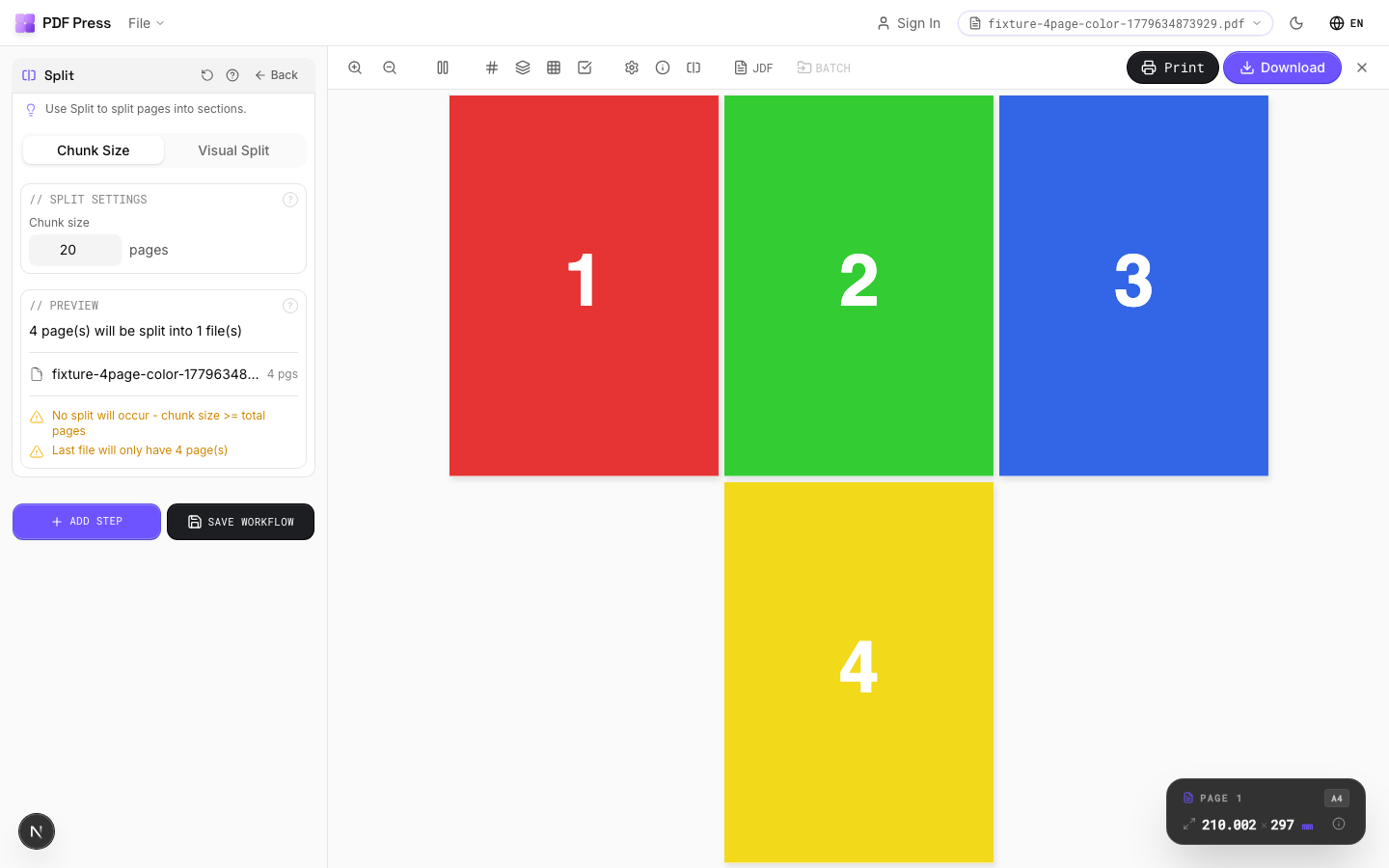
Three modes. Chunk splits by fixed page count (a 100-page PDF at chunk size 20 = 5 files). Visual lets you click between page thumbnails to place split points exactly where needed. Both download as a zip archive of individual PDFs. Spread is different in kind: it cuts each wide two-page spread down the middle into two single pages, producing ONE file with twice the pages rather than many files. Use Spread when a design export gave you reader spreads (pages 2-3 side by side) and you need single pages to impose a booklet from.
Print examples made with Split
See the imposed output and finished piece together, then open the exact preset and production specs.
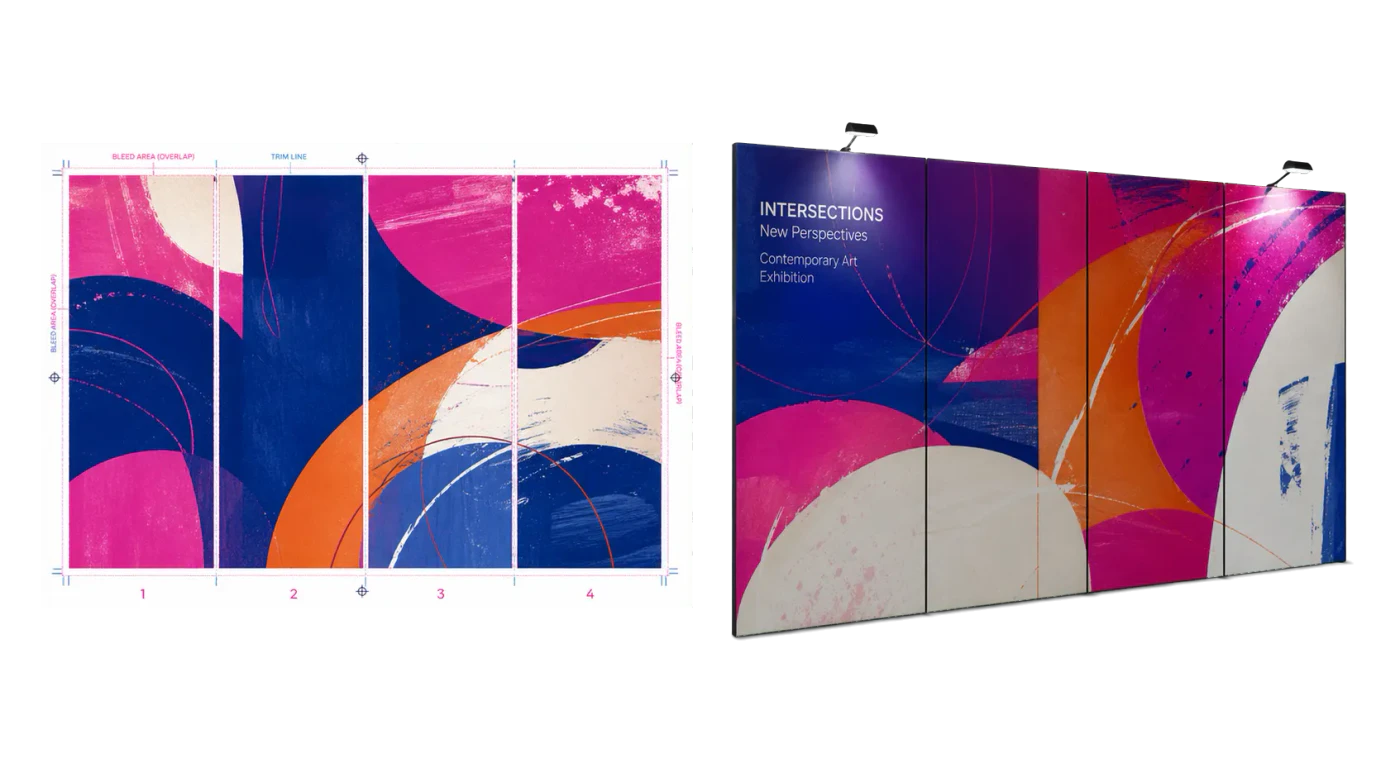
Original PDF Press print-production photography. Images link to their canonical template pages.
How to use Split
Upload files
Start with your source PDF or image files. Processing happens locally in the browser.
Add Split
Configure Spread Splitting, Split Settings, Preview and any production settings that match the job.
Preview the result
Check page order, marks, scaling, and output geometry before committing the export.
Download output
Export the finished PDF for proofing, press, finishing, or another PDF Press step.
Best use cases
Key settings
Spread Splitting
Cuts each two-page spread into two single pages, so a Booklet step imposes them correctly.
Detection measures every page and compares them: a spread is a page twice as wide (or twice as tall) as another page at the same size on the other axis. Only pages matching the detected spread size are cut; single-width covers pass through untouched, so the page count stays right. Auto splits only when the evidence is unambiguous. If every page is the same landscape size there is no narrower page to compare against — one wide page and two pages side by side are geometrically identical — so Auto reports what it suspects and declines to cut; choose "Split all" to confirm. "Off" keeps the step in place without applying it. Spread splitting always runs on the source pages before any layout step, whatever order the steps are in.
Split Settings
Set how many pages each output file should contain.
Chunk mode: every output file gets the same number of pages (the last file may have fewer if the total doesn't divide evenly). Visual mode: click between page thumbnails to place split boundaries manually — useful when chapters or sections don't have uniform page counts.
Preview
Shows the split plan — output files and page ranges, or the detected spread count.
In Chunk mode this lists the output file names and their page ranges. In Spread mode it reports how many spreads were detected, the detected spread size and cut direction, how many single pages are passing through untouched, and any pages skipped for having an unexpected size.
Visual Pages
Interactive page thumbnails — click between pages to toggle split points.
Each red line marks a split boundary. Click to add or remove. The resulting files are listed below with their page ranges. Drag to reorder split points is not supported — click to toggle on/off instead.
Action
Download all split files as a single zip archive.
Expert tip
Split large-format pages into press-sheet-sized tiles with 10 mm overlap for accurate reassembly. 10 mm is the standard for most wide-format tiling jobs.
When splitting a booklet spread back into single pages, split at the exact spine position. Even 1 pt off will show as a white line at the bind edge.
Production recipes using Split
Reader Spreads → Saddle-Stitch Booklet
Cut a spread PDF into single pages, then impose it. The fix when a design export gave you pages 2-3 side by side.
Banner Printing
Wide-format banners with tiling for roll-fed printers.
Trade Show Panels
Multi-panel trade show displays split for separate printing and assembly.
Vehicle Wrap
Vehicle wrap panels split for contour-cut application.
What print pros say
We ran Quite Imposing on Acrobat for years. PDF Press does the same booklet and N-up impositions right in the browser, with no plug-in and no per-seat licence, and it's genuinely quicker to set up.
Best browser tool I've found for booklet printing. Saddle-stitch, perfect-bound signatures, automatic page imposition, and our zine and catalogue clients love the turnaround.
Moved our team over from pdfsnake. Same step-and-repeat and gang-up work, but the live preview means we catch creep and bleed problems before the plate, not after.
Frequently asked questions
What is Split used for?
Divides a multi-page PDF into smaller files, or cuts two-page spreads into single pages.
Who should use split PDF?
It is built for operators separating signatures, spreads, tiles, and production batches. Common use cases include File Splitting, Distribution, Batch Processing, Reader Spreads.
Do my PDF files upload to a server?
No. PDF Press runs the PDF processing workflow in your browser, so your files stay on your device.
Can I use Split with other PDF Press tools?
Yes. You can combine it with other PDF Press tools in a multi-step workflow, then preview and export the final PDF.